Getty Images and the AI Disruption Question: What Happens When Technology Changes Your Business Model?
Getty Images’ October 2026 financial restructuring is a reminder to distinguish a confirmed company event from a broader technology story. Getty said it would continue operating normally through the process. Its announcement does not say AI alone caused the restructuring. Separately, generative AI is changing how some customers can create and source images. The useful question for other businesses is how a technology shift changes customer expectations, costs and the value they pay for.
What Getty announced—and what it did not
On 21 October 2026, Getty Images announced that certain US entities had commenced voluntary Chapter 11 proceedings to implement a previously disclosed financial restructuring. The company described the process as addressing its capital structure and certain non-operating legal liabilities, with a proposed investment and significant debt reduction. It said it expected to continue operating in the ordinary course, serving customers and supporting contributors during the process.
That is a financial restructuring, not a notice that Getty Images has ceased trading. Nor does the announcement attribute the restructuring to generative AI. AI’s effect on visual-content markets is a separate strategic question. Treating the timing of two developments as proof of causation would overstate what the company’s filing establishes.
AI is changing the economics of some content
Generative tools can produce or adapt some images quickly and at relatively low marginal cost. That can increase the volume of available content, shorten early concepting and let a small team explore more visual directions before commissioning a finished asset. It may also change what customers expect to receive as part of a design, marketing or communications service. Those are shifts in production options and expectations, not evidence that every AI image is suitable for every commercial use.
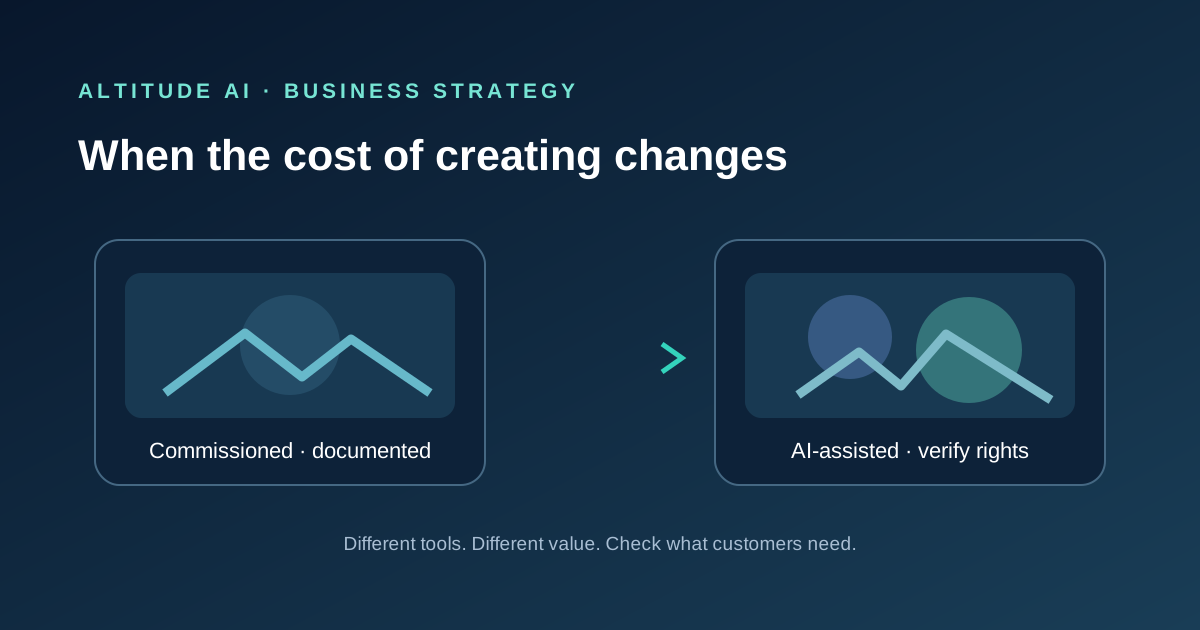
The value equation depends on purpose. A draft visual for an internal presentation has different requirements from an editorial photograph documenting a real event, a product image that must match an item exactly, or campaign artwork where rights, provenance and brand consistency matter. Quality, accuracy, editability, licensing, disclosure, indemnity and workflow fit all affect the actual cost. AI may lower one production cost while adding review, legal or correction work elsewhere.
Established businesses have assets beyond the output
A supplier’s value may include trusted provenance, access to authentic material, verified rights, specialist curation, consistent technical quality, reliable service and a relationship that helps a customer choose. These advantages can matter when an organisation needs a real image of a real person or event, a clear chain of permissions, or a provider who can resolve a licensing question. They are not automatically displaced because a model can generate a plausible picture.
At the same time, provenance and licensing should be checked rather than assumed. The legal and contractual treatment of generated content can depend on the tool, its terms, the source material, jurisdiction and use. AI-generated imagery is not automatically safe for commercial use, and a stock licence does not automatically answer every question about a particular campaign. A business should verify the rights and conditions relevant to its own use.
Ask what customers value—not just what AI can make
For an SME, the relevant questions are practical. Which parts of an offering are becoming easier for a customer to reproduce? Which parts depend on expertise, trust, judgement, service or access to scarce information? Could AI reduce the time or cost of delivery without weakening the outcome? Are competitors using it to offer faster turnaround or a new service? What new expectations are customers expressing, and which are only vendor predictions?
Do not begin with a purchase decision. Begin with customer conversations, current costs and examples of work. Identify where demand is changing and what quality must be preserved. Compare an AI-supported workflow with existing suppliers, manual work and simpler alternatives. Include review, correction, rights, training and integration in the cost. If the customer values authenticity, accountability or a human relationship, those may be part of the product rather than overhead to remove.
Protect, improve, develop and measure
A practical review has four parts. Protect: identify the strengths customers already value and the obligations the business must continue to meet. Improve: test whether AI can reduce friction, improve turnaround or make delivery more consistent. Develop: explore whether new services or formats become practical. Measure: track cost, quality, customer outcomes and profitability, not just the number of images or drafts produced.
Keep experiments small enough to compare with a baseline. Set a clear purpose, use approved tools and data, check rights and quality, and define who approves external work. If customer response, correction rates or margins worsen, pause and learn rather than expanding on the basis of activity metrics. The same discipline applies to other sectors: a tool’s novelty does not determine whether it improves the business model.
Adaptation is better than panic
AI can change the economics of tasks without eliminating the value of the whole business. The risk may be that competitors use technology to change what customers expect, while an established provider continues to price or deliver as before. The opportunity may be to use AI internally, bundle expertise differently or serve a customer need that was previously too costly. Both possibilities require evidence about a particular market, not a prediction drawn from a headline.
Getty’s restructuring is a specific financial event with stated causes and terms; AI’s effect on the image market is a separate source of strategic pressure to evaluate. An Altitude AI Discovery Review can help businesses assess market changes, processes and opportunities before committing to new tools. The sensible first step is to identify where customer value is changing, then test one response and measure the result.