AI Agents Are Getting Their Own Work Identities. Is Your Business Ready to Employ Digital Workers?
An AI agent with a work identity may be easier to distinguish from an employee in a chat or audit log. The identity does not make it a member of staff, transfer accountability or prove that the feature is available to every business.
What Google announced
On 8 October 2026, Google Cloud announced the Gemini agent at its Gemini at Work event. In the announcement, Google described a “coworker agent” as an agent with an ongoing team role and said it could receive its own Workspace account, including an email address, calendar, Drive and presence in the company directory. Google also described dedicated agent email addresses and persistent storage.
That is a product announcement, not proof that every Google Workspace customer can create one today. The post does not set out a general availability date, all eligible plans, regional rollout or complete pricing for coworker agents. Businesses should confirm current access and terms directly with Google before writing a deployment plan or making a purchase decision.
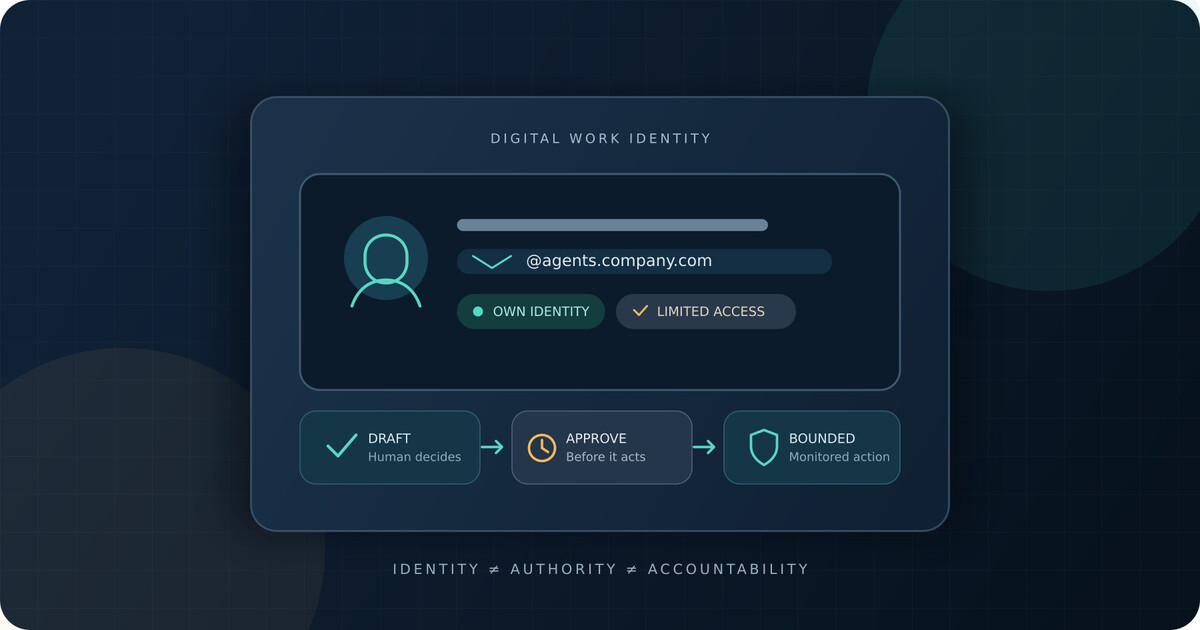
Google says agents act under their own identity and only see context shared with them. It also describes administrator-approved permissions and audit records attributed to an agent. These are the provider’s stated product controls; an organisation still needs to configure permissions, validate logging and test how exceptions are handled.
An identity helps with traceability, not responsibility
A separate email or account could make it clearer whether a message, document change or calendar action came from software. That may help teams inspect what happened and revoke access without disabling an employee’s personal account. It can also make a delegated role easier to name and manage.
But an account is not an employee, and an audit trail does not decide whether an action was appropriate. The business and its human owners remain responsible for the work they delegate. A labelled sender can still send the wrong message, use confidential information badly or create a commitment that nobody meant to make.
For related guidance on access boundaries and ongoing responsibility, read how to control AI agents before they access business systems and why persistent AI agents need clear owners.
From assistant to digital worker
A chatbot answers a question. An assistant may help prepare a draft or retrieve information. An agent can use connected tools to carry out a task, and an agent with delegated authority may change a record, schedule a meeting or send a message. Those are different levels of access and consequence; they should not be treated as one feature called “AI”.
For an SME, a cautious first use might classify new enquiries, prepare a daily internal summary or draft a response for a staff member to check. Updating a customer record or scheduling an internal meeting may be reasonable within clear limits. Sending an external promise, changing payment details or issuing a refund has a different consequence and needs stronger controls.
Google’s announcement illustrates how an agent might take part in a team chat or document under its own identity. It does not show that every use case is accurate, safe or commercially useful. The value depends on the actual process and the effort required to supervise the result.
Set the authority before connecting the tools
A practical starting framework has three levels. At “assist”, the agent finds information and prepares drafts; a person decides and acts. At “act with approval”, it prepares a specific action and waits for a named person to authorise it. At “act within limits”, it can complete a low-risk, repeatable task independently, but only within agreed boundaries and with monitoring and escalation.
These levels are a business decision aid, not an official Google framework or industry standard. The same agent might be allowed to prepare a customer email but not send it, or update a low-risk internal field but not change a contract or payment. Set the level for each process, not for the technology as a whole.
Define the allowed data, tools, recipients, spending or transaction limits, working hours and exception path. Give the agent the minimum permissions necessary. Restrict what it can send externally, preserve a way to stop work and revoke access, and ensure logs identify the action without exposing more personal or confidential data than needed.
Start with a controlled, measurable pilot
Choose a repetitive task with a clear output and a person who owns the process. Before connecting the agent, document the existing time, error and escalation rates. Test it on non-sensitive examples, check whether it follows instructions when information is incomplete or conflicting, and see whether it can be redirected by untrusted content in a document or message.
During the pilot, review every action and record corrections, human interventions and time spent checking. Keep external communication and irreversible changes behind approval until the team has evidence that the process behaves as expected. Agree who receives alerts, how quickly they must respond and what happens if a system is unavailable.
Expand only if the measured benefit exceeds the cost of licences, setup, oversight and exception handling. Keep an owner responsible for permissions and regular reviews, and remove the identity when the role ends. A digital worker is a new way of delegating work, not a way of delegating accountability.
Employ the process carefully, not the product name
An AI agent’s own identity may improve traceability and make access easier to separate. It does not by itself establish trust, accuracy, availability or a return on investment. Those depend on the task, the information shared, the authority granted and the people who monitor the work.
For a small business, the sensible question is not whether an agent can have an email address. It is whether a defined process can be improved without giving software more authority than the organisation can supervise. Start with a narrow pilot, keep a human owner and expand only when the evidence supports it.